
Three Weeks I Will Never Forget
By Rebeca - 3 week intern
When I decided to come to Kindred Spirit Elephant Sanctuary, I thought I was coming to learn about elephants. What I didn't know was that I would also learn about people, a different way of living and, in many ways, about myself.
Although my alarm went off at six every morning, after a couple of days I no longer needed it. Little by little, your internal clock begins to follow the rhythm of the village and above all the sound of the roosters announcing a new day.
As I stepped outside, still dreaming about my first coffee, the village was already awake. Motorbikes, chickens, dogs, children getting ready for school and neighbours beginning a working day that always seemed to start long before ours. It was impossible not to feel that even if only for a few weeks, I had become part of that daily rhythm.
One of the greatest gifts of this experience has been the people.
Cristina and the whole team: Celia, Lucía, Tilly, Kanda, Rose, Nee, Daniela, and Keleveh together with the mahouts, achieve something truly remarkable: they make a place that welcomes volunteers from all over the world still feel like a family.
Behind every activity there is an enormous amount of work that often goes unnoticed. Caring for the elephants, coordinating the mahouts, welcoming visitors, carrying out research, solving unexpected problems... Everything happens with a naturalness that you only truly appreciate once you are here.
I also discovered the incredible dedication of the mahouts. Beyond the image many of us have before arriving, I found people who know their elephants as if they were members of their own family. Every elephant has a different personality, different preferences, fears and little quirks—and the mahouts know every single one of them.
And then, of course, there are the elephants themselves.
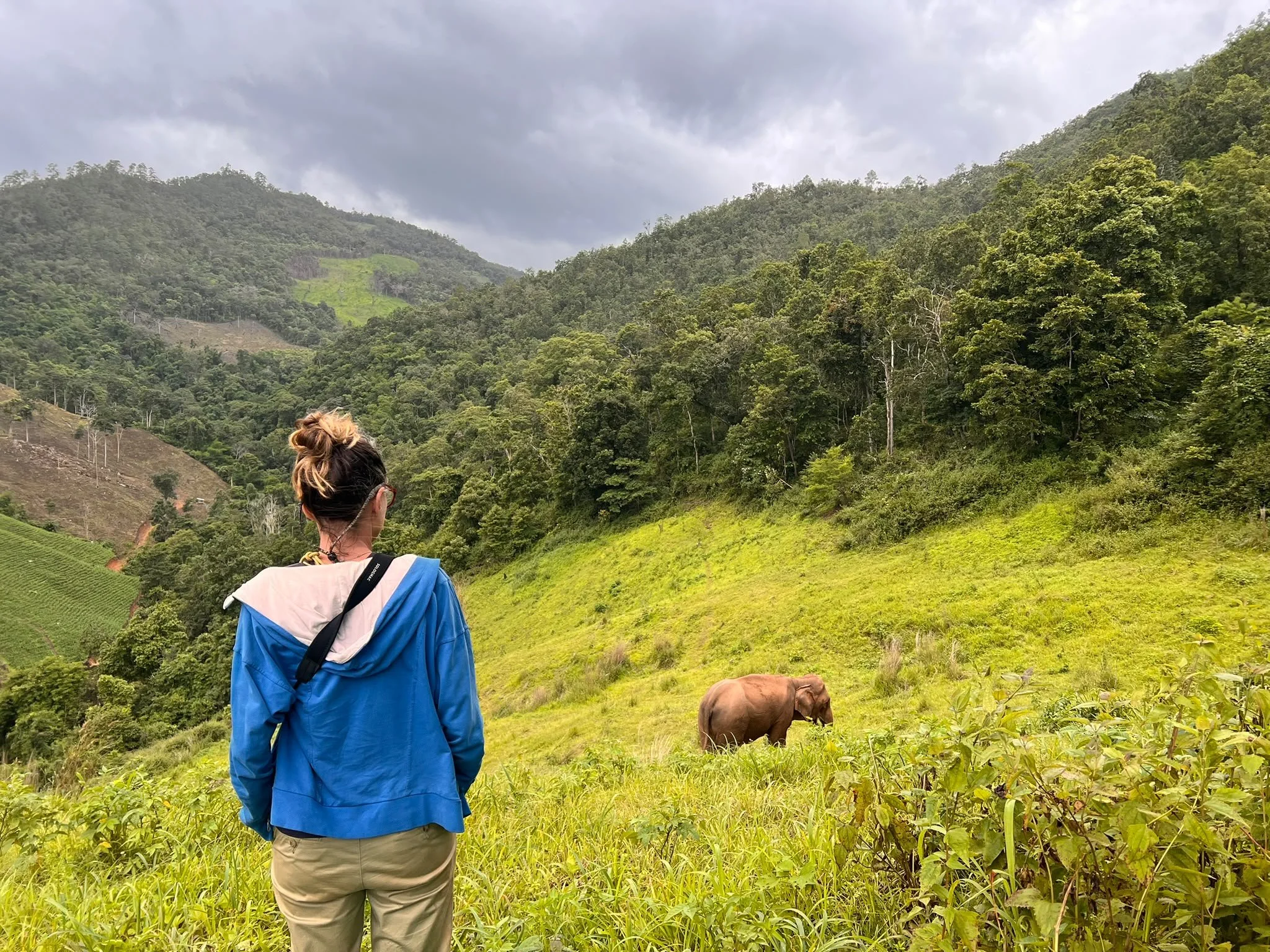
Mae Doom, Too Meh, Wan Mai, Sri Prai, Dodo, Boon Rott... and little Junior, who steals your heart simply by being a young elephant with endless curiosity completely unable to resist playing with vines. Watching them for hours has undoubtedly been one of the most beautiful experiences of my journey.
But KSES is not only about elephants.
It is also about Minoi and her siblings, the dogs who always seem to appear at exactly the right moment, quietly waiting while we work. Without even trying they have become part of the sanctuary's identity.
And then there is my landlady, Seeva. One of those people who, despite sharing very few words, somehow makes you feel at home from the very first day. Some gestures need no translation: a smile, a meal prepared with care or simply making sure that you are doing well.
Food has also been part of the adventure. Every day brought new flavours, ingredients I had never tasted before and a completely different way of experiencing meals. Sometimes I loved everything. Other times... not quite. But that is also part of travelling: stepping outside your comfort zone and allowing another country to surprise you.
Perhaps the most valuable lesson of these three weeks has been the rhythm of life.
Here, the day revolves around the needs of the animals, shared work and a much simpler lifestyle than the one many of us are used to. And somehow that simplicity becomes contagious.
I came here to learn about animal welfare behaviour and conservation. I am leaving with all of that... but also with conversations shared around the table, or while walking through the forest in search of our elephant friends. With people from different parts of the world sunrises over the mountains, evenings listening to mosquitoes buzzing while sharing a film, and the feeling of having experienced something truly authentic.
The elephants were the reason I came.
The people taught me what this place is really about.
And perhaps that is why I am leaving with something more than memories.
I am leaving with hope.
Not because this place offers a perfect solution but because I have met people who dedicate their lives to giving these elephants as much freedom, dignity and welfare as possible within an incredibly complex reality.
People who strive to teach us about elephant behaviour and welfare. People who encourage us to understand them and to respect that elephants too, have lives of their own, their own needs and their own way of experiencing the world. People who remind us that human beings are not the only species capable of feeling, and that perhaps we need to stop looking only at ourselves if we want to learn how to share this planet with other living beings in a more respectful way.
During these weeks I have come to understand that conservation does not always mean returning an animal to the wild. Sometimes it means respecting its past, adapting to its individual needs and allowing it to live surrounded by forest, making choices, building relationships and expressing natural behaviours whenever possible.
There is one sentence that has stayed with me more than any other.
While preparing for a documentary, one of the mahouts was asked:
"What would the elephants say if they could speak?"
Without hesitation, he replied:
"Give me my home back."
I believe those five words capture the greatest challenge of conservation.
No sanctuary will ever replace the home these elephants lost.
But while returning home is no longer possible for them, places like KSES work every single day to offer them a life that is as close as possible to the one nature originally intended.
And perhaps that is the greatest lesson I will take home from Thailand:
The greatest act of love we can offer an animal is not to make it depend on us, but to give back, whenever possible, the freedom it once lost.
Da blu. Gracias. Thank you.
